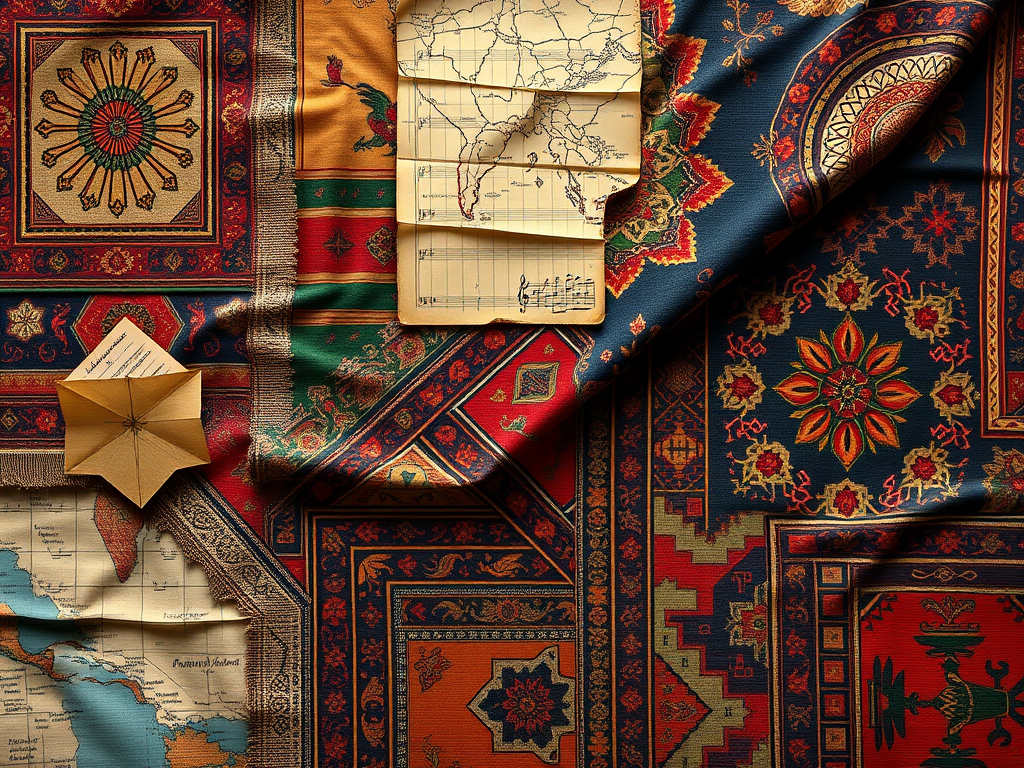
While peoples express their sorrows through patterns and their hopes through melodies, imperialists have meticulously observed, archived, and deciphered these expressions. For them, a folk song, a carpet motif, or a tradition was not merely a cultural artifact but a means to decode geography, divide populations, and suppress rebellions.
“The people sing; the imperialist deciphers the notes.”
@stratejivefikirler
British Empire: Decoding Codes in Indian Fabrics
The British did not merely occupy lands in India; they occupied meanings. In the 19th century, ethnographic officers dispatched to the region analysed how colour schemes in local attire varied according to the caste system. These codes were utilised to identify villages preparing for rebellion. Subsequent sudden raids subdued the populace.
“Colour guides not only the eye but also the map.”
@stratejivefikirler
French Colonialism: Resistance Motifs in Berber Carpets
In Algeria, the French analysed the patterns in carpets woven by Berber tribes to determine which tribes were actively resisting. French intelligence officers prepared reports noting that “carpets with dense zigzag motifs symbolise resistance” and issued special orders to suppress this folk art.
“He who can read the motif can map the people’s resistance.”
@stratejivefikirler
USA: Tracking Rebellion Through Peasant Songs in the Vietnam War
During the Vietnam War, the CIA analysed changes in traditional songs sung by peasants. Operating under the hypothesis that “if anti-war themes increase, the area is under Viet Cong control,” they identified guerrilla regions through song analysis. This stands as one of the most striking uses of cultural intelligence.
“If the melody guides, the map is unnecessary.”
@stratejivefikirler
Belgium: Transforming Ethnographic Codes into Death Lists in Rwanda
Belgium documented the facial structures, traditional clothing, and naming patterns of the Tutsi and Hutu ethnic groups in Rwanda, labelling the population. This “cultural classification” paved the way for the genocide years later. Using culture not to decode but to create codes is the most dangerous form of intelligence.
“Understanding culture is knowledge; dividing it is the most savage intelligence.”
@stratejivefikirler
Spain: Transforming Shamanic Symbols in Latin America
Spanish colonisers first interpreted the shamanic symbols used by indigenous peoples, then declared them “demonic” and suppressed them. However, when some symbols became emblems of rebellion, Spanish intelligence priests tracked these symbols to identify centres of uprising. Thus, esoteric motifs were transformed into maps.
“A sacred symbol, if observed long enough, becomes a target.”
@stratejivefikirler
USSR: The Whisper of Independence Through Patterns in Central Asia
The Soviet Union identified that increasing elements like “ancestor figures” and “bow-arrow themes” in traditional fabrics woven in Turkestan reflected the idea of independence. Workshops promoting such patterns were shut down, and the people were suppressed through ethnographic intelligence.
“A motif becomes a nation; if you look closely, independence winks.”
@stratejivefikirler
Why Do Imperialists Love Cultural Codes?
Because these codes run deeper than language. It is impossible to govern without infiltrating and understanding the people. This is why imperialists first sent musicians, then inspectors; first ethnographers, then soldiers. They read the patterns before suppressing the people.
“Imperialism conquers land with maps, and people with patterns.”
@stratejivefikirler
Even today, this method is not forgotten. Modern intelligence agencies convert cultural behaviour patterns into algorithms. Millions of social media posts may appear as folkloric content but are, in fact, data sets. Culture remains a map; a motif remains a message.
“Decoding is a technological task; but understanding the code requires cultural knowledge.”
@stratejivefikirler
Gürkan KARAÇAM
#France #England #ABD #Germany
 Gürkan KARAÇAM
Yorum bırakın